
In the past I have shared misinformation that I believed to be true, that the Syrian Civil War in 2011 was caused by Drought and Climate Change. This is not incorrect, but is misleading and minimizes the role of mounting political instability brought by the global West. There was still a fantastic graphic story comic published about the issue, that while it may not be up to date information, is still a fantastic piece of digital media to check out. Included after this excerpt from On Blaming Climate Change for the Syrian Civil War - MERIP
On Blaming Climate Change for the Syrian Civil War
Forthcoming in MER issue 296 “Nature and Politics"
Jan Selby 09.29.2020
The catastrophic war in Syria has been, for years now, regularly identified as partly caused by human-induced climate change. Climate change, it is said, was at work in a severe pre-civil war drought in northeastern Syria.
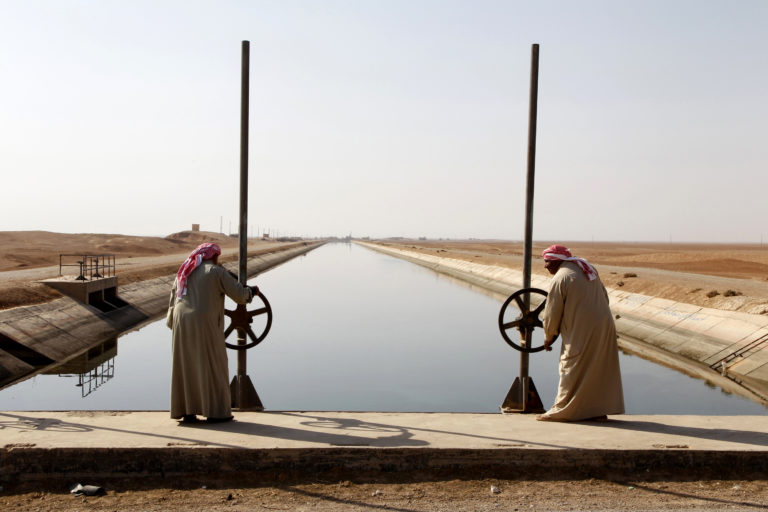
A water canal running from the Euphrates river into the semi-desert region of eastern Syria, 2010. Khaled al-Hariri/Reuters
This drought, it is claimed, caused large-scale out-migration from the region. And this migration, it is argued, exacerbated the internal socio-economic stresses which underpinned the country’s 2011 protests and ultimate descent into war. Western political leaders, international organizations, environmental non-governmental organizations (NGOs), defense think tanks and countless academic, activist and media commentators have all made this case. Both within the Western liberal mainstream and within much radical green and red-green thinking—from former US President Barack Obama to Extinction Rebellion—the Syrian conflict is seen as not only a horror in its own right but also as an early indication of what awaits the world as the planet continues to warm.[1]
These claims cannot be rejected entirely, if only because most phenomena are in one way or another connected, however indirectly, and because it is impossible to demonstrate the non-existence of causal connections. And yet, as Omar Dahi, Mike Hume, Christiane Fröhlich and I have shown elsewhere, and as others have also found, the Syria climate conflict narrative is deeply problematic.[2] Not only is the evidence behind this narrative weak. In addition, it masks what was really occurring in rural Syria (and in the country’s northeast region in particular) prior to 2011, which was the unfolding of a long-term economic, environmental and political crisis. And crucially, the narrative largely originated from Syrian regime interests in deflecting responsibility for a crisis of its own making. Syria is less an exemplar of what awaits us as the planet warms than of the complex and uncomfortable politics of blaming climate change.
Read more at https://merip.org/2020/09/on-blaming-climate-change-for-the-syrian-civil-war/





Comments (0)